
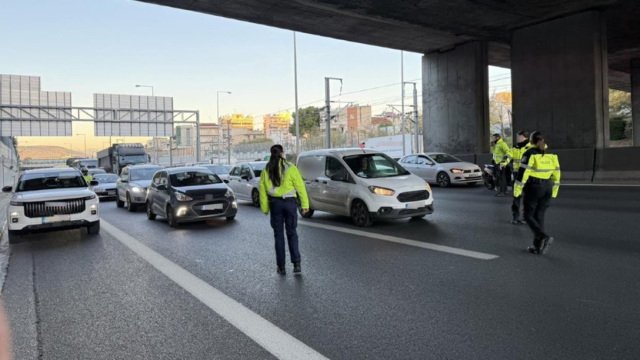
A noticeable decrease in fatal road accidents has been recorded in Attica during the first six months after the full implementation of the new Road Traffic Code, according to data from the Attica Traffic Police Directorate.
Specifically, in the six months from September 2025 to February 2026, 54 fatal accidents were recorded, compared to 74 during the same period a year earlier, representing a reduction of about 27%.
During the same period, road deaths in Attica dropped from 75 to 57, marking a decrease of about 24%.
A similar trend appears in serious accidents. Before the implementation of the new code, 69 serious accidents had been recorded, while in the six months after its implementation the number fell to 46, a drop of about 33%. At the same time, seriously injured victims from road accidents decreased from 75 to 49, about 35% fewer.
This picture is also accompanied by a significant increase in alcohol-driving checks.
Specifically, during the six-month period September 2025 – February 2026 (up to February 20), around 480,000 breathalyzer tests were carried out on drivers, compared with about 69,000 in the same period the previous year.
Despite the much higher number of checks, the number of positive alcohol tests remained nearly the same (6,078 vs. 5,967). However, because of the huge increase in checks, the percentage of positive tests dropped significantly, from about 8.6% to 1.3%.
Police Deputy Director Dimitrios Papageorgiou, head of the Coordination & Traffic Accident Prevention Department of the Attica Traffic Police Directorate, spoke to the Athens-Macedonian News Agency about these figures and the changes observed in drivers' behavior after the implementation of the new code.
Asked about the reduction in fatal accidents over the last six months, Papageorgiou said:
"The picture recorded over the last six months is indeed encouraging and fills us with cautious optimism. The reduction in fatal accidents is not random; it is the result of the combined effect of the new, rationalized Road Traffic Code and the intensification of our inspections. Every life saved on the asphalt is a victory for us, but the effort must be continuous. The data show that we are on the right track, but we are not complacent."
Regarding whether there has been a change in drivers' behavior since the new code came into effect, he said:
"We observe a gradual but clear shift. The full implementation of the new Road Traffic Code appears to have acted as a catalyst. Drivers are now more careful, as they know that penalties are not only financial but also focus on the removal of driving licenses and preventing repeat offenses. There is greater awareness of the consequences of dangerous driving."
Commenting on the decrease in positive alcohol tests despite the increase in checks, he noted:
"This is perhaps the most hopeful finding. The fact that we conduct more checks and find fewer drivers under the influence of alcohol means that the message 'alcohol and driving don't mix' has begun to take root in social consciousness. Drivers now choose alternative ways of transportation when they plan to consume alcohol, which is a huge step for road safety."
When asked about the main causes of fatal accidents, he said:
"Excessive speed remains the 'mother' of fatal accidents, especially during late-night and early-morning hours. Also, distraction due to mobile phone use remains one of the main causes of accidents. As for motorcyclists, although helmet use has increased, not wearing a helmet remains the main cause of serious injuries."
Regarding operational changes within the Attica Traffic Police after the new code came into force, he said:
"With the introduction of the new Road Traffic Code, our operational philosophy was radically upgraded, following the guidelines and firm will of our political and police leadership for zero tolerance toward road violations. At the forefront of this effort is the Traffic Accident Control and Prevention Unit (OEPTA). By decision of the leadership, OEPTA was significantly strengthened in personnel and technical infrastructure, allowing us to operate with greater flexibility and effectiveness. The unit's actions are now targeted and dynamic, focusing on 'smart' roadblocks and surprise checks at high-risk locations identified through continuous accident mapping. The expected operation of modern technological tools in the near future (such as smart cameras and digital recording systems), combined with OEPTA's specialized actions against critical violations—such as street racing, excessive speed, and drunk driving—will make our presence on the roads more interventionist, meaningful, and above all preventive."
Asked about the role of prevention versus enforcement, Papageorgiou emphasized:
"Enforcement is necessary for compliance, but prevention is what saves lives in the long term. The Attica Traffic Police Directorate consistently invests in public awareness and the cultivation of road safety education from childhood. Our goal is not to impose fines, but to reach a point where fines are unnecessary because drivers have internalized safety rules."
Responding to those who consider the new Road Traffic Code particularly strict, he said:
"I would call it a rationalization rather than strictness. The new code reflects the value of human life. It is not a 'punitive and strict' law, but a law that protects the conscientious driver, the pedestrian, and the passenger. 'Strictness' stops where responsibility begins. Anyone who respects the rules has nothing to fear."
Finally, when asked for his main message to drivers, he stressed:
"My message is simple: Road safety is everyone's responsibility. Every time we take the wheel, we hold in our hands not only our own lives but also the lives of others. Drive with respect, prudence, and without haste. A destination has value only when we reach it safely."
Πηγή: en.protothema.gr