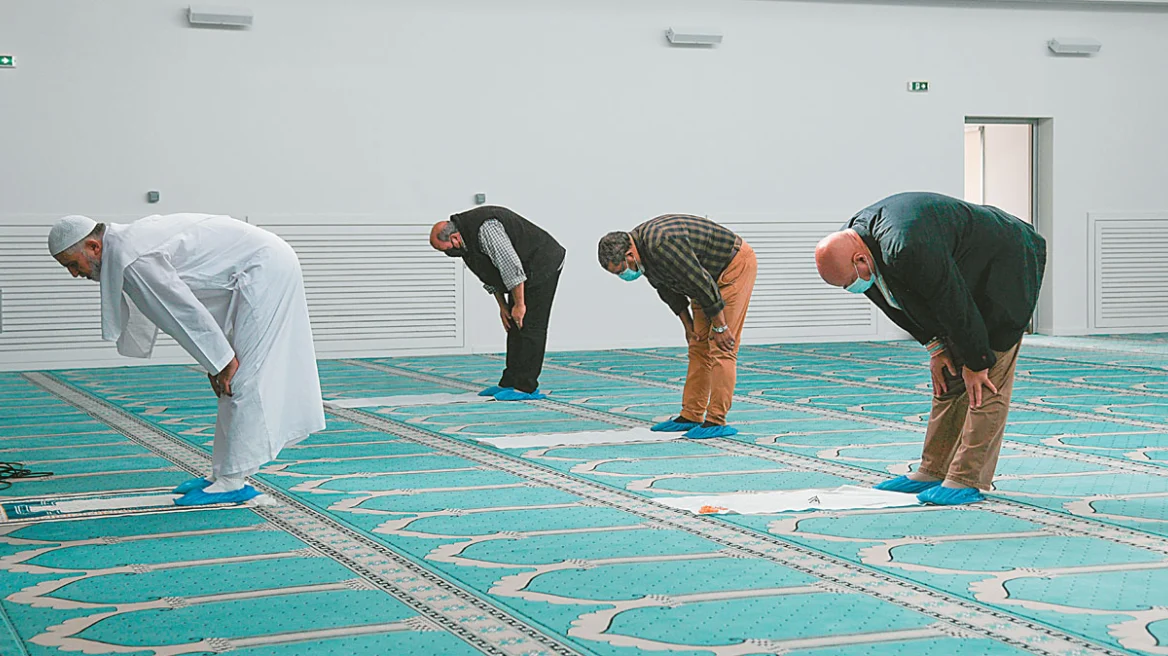
Thirteen licenses for the operation of worship spaces–mosques have been issued by the Ministry of Education and the competent General Secretariat for Religious Affairs: 12 of them operate in Attica and one in Thebes, in addition to the Athens mosque in Votanikos. Based on this, an operation is underway to fully map illegal mosques in Athens and Piraeus, in implementation of a recent law that provides not only for the sealing of an illegal place of worship but also for the deportation of the imam if he is a foreign national, with the immediate revocation of his residence permit in Greece.
According to estimates, illegal mosques in Attica number between 60 and 80, a significantly smaller figure compared to the period before the operation of the Islamic mosque in Votanikos — the official mosque of Athens, which, after many setbacks, began operating in 2020. Until then, apartments, basements and warehouses were operating illegally as mosques and places of worship and prayer, but as security officials pointed out, they were often also gathering places even for extremists, "where no one really knew what was going on."
"It is not enough"
The situation began to change with the operation of the mosque in Votanikos. "Unfortunately, the space is small and relatively far away; however, we have people who pray here regularly, as well as others who come to pray while visiting Athens, especially during this period of Ramadan," Athens' imam, Zaki Sidi Mohamed, told "THEMA." He believes that because the Votanikos mosque is not sufficient, "informal," as he described them, worship spaces continue to operate, estimating that there are about 80 in Attica.
In 2014, the Council of State ruled that the construction of an Islamic mosque was not only legal but also served the public interest — namely, meeting the religious needs of Muslims living in Athens — paving the way not only for the Votanikos mosque, which ultimately opened six years later, but also for other worship spaces of recognized religions. Last summer, alongside the legal recognition of the Alevi-Bektashi Muslims of Thrace by the Ministry of Education, a series of strict terms and conditions for the operation of worship spaces was legislated. These are categorized as prayer houses (up to 200 sq.m.) and temples (over 200 sq.m.). In the first case, licensing is easier; in the second, requirements are more demanding.
The legislator's aim was to uphold the spirit and directives of the Council of State decision and to shape a modern, complete and coherent framework for worship spaces of religious communities in order to facilitate religious freedom for all. Among other requirements, a permit for a place of worship requires an application by at least five individuals and one religious minister, provided that, if they are foreign nationals, they reside legally in Greece. It is also mandatory to clearly declare the religious community to which they belong. The permit is revoked if violations of the law or public order are found, if there are national security concerns, or if religious services cease for more than six months.
Strict conditions
Licenses are issued in the name of religious ministers, but they may not simultaneously use the premises as their primary residence. The conditions for remaining registered in the relevant registry (Article 14 of Law 4301/2014) are particularly strict. The law also includes provisions regarding incitement to disobedience, the commission of crimes, and terrorist acts. The risk that places of worship could be used as shelters for extremist elements and radicalization also places illegal mosques under the surveillance of the competent services of the Hellenic Police. However, according to sources from the Ministry of Citizen Protection, such elements are not currently present, and therefore illegal mosques are not a high priority.
By contrast, the goal of ending their operation is a priority for the Ministry of Migration and Asylum. Applying this policy, the ministry has already proceeded with sealing two illegal worship spaces in the Agios Panteleimonas area, in cooperation with the Hellenic Police. At the same time, implementing a provision introduced by the Ministry of Education, it is also moving forward with the immediate deportation of religious ministers. According to the legislation, places of worship that are built or operate without a permit from the Ministry of Education are closed and sealed by the Police. Anyone who owns, builds, or puts into operation a place of worship without the required permit, or alters its use in violation of the permit granted, faces imprisonment and an administrative fine. If they are foreign nationals, they are deported; if they are third-country nationals holding a residence permit in Greece, the permit is revoked without a deadline for voluntary departure.
Πηγή: en.protothema.gr